AI Care: Artificial Intelligence for treating Cancer therapy Resistance
Laufzeit: 01.04.2024 - 31.03.2030
Partner: RPTU Kaiserslautern-Landau Deutsches Krebsforschungszentrum (DKFZ) Heidelberg Universität Heidelberg
Förderung durch: Carl Zeiss Stiftung, CZS Breakthroughs
Projektmittel (€): 5000000

Kurzfassung
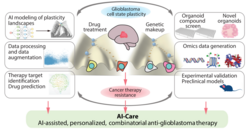
Glioblastomas are aggressive brain tumors characterized by a high degree of phenotypic heterogeneity and plasticity. Their ability to transition into resistant cell states makes conventional therapies fall flat. The project team of Prof. Dr. Naim Bajcinca at the Rhineland-Palatinate Technical University Kaiserslautern-Landau (RPTU) and Dr. Bernhard Radlwimmer at the German Cancer Research Center (DKFZ) in Heidelberg will use AI to explore and solve this challenge.
The goal is to develop an AI...Glioblastomas are aggressive brain tumors characterized by a high degree of phenotypic heterogeneity and plasticity. Their ability to transition into resistant cell states makes conventional therapies fall flat. The project team of Prof. Dr. Naim Bajcinca at the Rhineland-Palatinate Technical University Kaiserslautern-Landau (RPTU) and Dr. Bernhard Radlwimmer at the German Cancer Research Center (DKFZ) in Heidelberg will use AI to explore and solve this challenge.
The goal is to develop an AI model that is able to identify the underlying key molecular processes of glioblastoma plasticity. On this basis, it is hoped to control the behavior of cancer cells, predict their response to drugs, and optimize personalized therapies for glioblastomas. The project team's work could open new avenues not only in the treatment of glioblastoma, but also other deadly cancers. The concept of AI-assisted personalized precision medicine could thus become a reality.» weiterlesen» einklappen
Veröffentlichungen

- Kastor, Michael U. L.; Rottmayer, Jan; Hundertmark, Anna et al.
- Parameter conditioned interpretable U-Net surrogate model for data-driven predictions of convection-diffusion-reaction processes